What’s the Difference Between Pick-and-Pack and Ship-From-Store?
In the fast-paced world of e-commerce and retail, efficient order fulfilment is critical to customer satisfaction and business success. Two popular fulfilment methods—pick-and-pack and ship-from-store—are often used by businesses to streamline their operations. But what exactly are these methods, and how do they differ? In this blog, we’ll break down the key differences, advantages, and disadvantages of each to help you decide which approach is best for your business.
What is Pick-and-Pack?
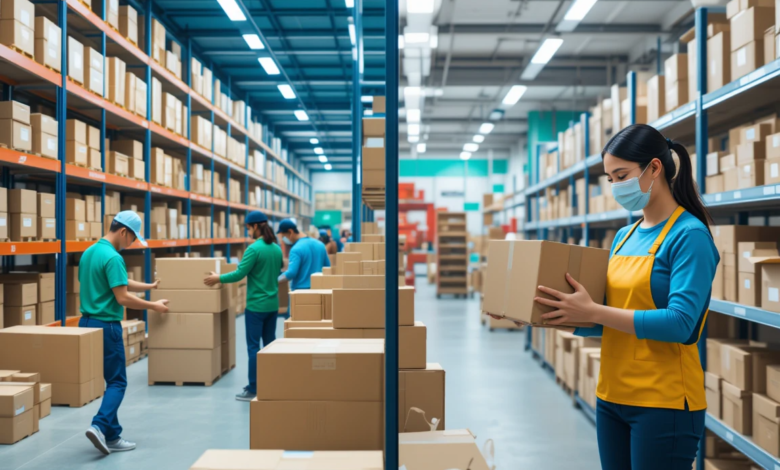
Pick-and-pack is a fulfilment method commonly used in warehouses or fulfilment centres. Here’s how it works:
- Picking: Workers retrieve items from inventory shelves based on customer orders.
- Packing: The items are packed into boxes or envelopes, ready for shipping.
- Shipping: The packed orders are handed over to a carrier for delivery to the customer.
This method is ideal for businesses with a centralised inventory system and high order volumes.
What is Ship-From-Store?
Ship-from-store is a fulfilment strategy where orders are shipped directly from retail store locations rather than a centralised warehouse. Here’s how it works:
- Order Receipt: A customer places an order online.
- Store Fulfilment: The order is picked, packed, and shipped with available inventory from the nearest retail store.
- Delivery: The order is sent directly to the customer from the store.
This method is particularly useful for businesses with multiple retail locations that want to use their physical stores as mini-fulfilment centres.
Key Differences Between Pick-and-Pack and Ship-From-Store
| Aspect | Pick-and-Pack | Ship-From-Store |
| Location | Centralised warehouse or fulfilment centre | Retail store locations |
| Inventory Management | Centralised inventory system | Decentralised inventory across stores |
| Order Volume | Best for high order volumes | Best for localised or smaller orders |
| Delivery Speed | Depends on warehouse location | Faster for local customers |
| Cost | Lower operational costs for bulk orders | Higher operational costs per order |
| Scalability | Highly scalable for growing businesses | Limited by store inventory and capacity |
Advantages of Pick-and-Pack
- Efficiency: Centralised operations make it easier to manage large order volumes.
- Cost-Effective: Bulk processing reduces per-order costs.
- Scalability: Ideal for businesses with growing order volumes.
- Accuracy: Advanced warehouse management systems (WMS) minimise errors in picking and packing.
Advantages of Ship-From-Store
- Faster Local Delivery: Orders can be delivered quickly to nearby customers.
- Inventory Utilisation: Helps clear excess stock from retail stores.
- Customer Experience: Reduces shipping times, improving customer satisfaction.
- Omnichannel Integration: Bridges the gap between online and offline sales.
Disadvantages of Pick-and-Pack
- Dependence on Warehouse Location: Delivery times may be longer for customers who are far from the warehouse.
- Upfront Costs: Requires investment in warehouse infrastructure and technology.
Disadvantages of Ship-From-Store
- Operational Complexity: Managing inventory across multiple stores can be challenging.
- Higher Costs: Shipping individual orders from stores can be more expensive than bulk shipping.
- Limited Scalability: Stores may not be able to handle large order volumes.
Which Method is Right for Your Business?
The choice between pick-and-pack and ship-from-store depends on your business model, order volume, and customer base. Here’s a quick guide to help you decide:
- Choose Pick-and-Pack If:
- You have a centralised inventory system.
- You handle high order volumes.
- You want to reduce per-order fulfilment costs.
- You’re looking for a scalable solution for growth.
- Choose Ship-From-Store If:
- You have multiple retail locations.
- You want to offer faster local delivery.
- You need to clear excess store inventory.
- You’re focused on creating an omnichannel customer experience.
Real-Life Examples
- Pick-and-Pack: Amazon uses its fulfilment centres’ highly efficient pick-and-pack system to process millions of orders daily. Their advanced automation and technology ensure fast and accurate order fulfilment.
- Ship-From-Store: Retail giant Walmart uses ship-from-store to leverage its extensive network of physical stores. This allows them to offer same-day or next-day delivery to local customers.
Conclusion
Both pick-and-pack and ship-from-store have their unique advantages and challenges. The right choice depends on your business needs, customer expectations, and operational capabilities. Pick-and-pack might be the way to go if you want a scalable, cost-effective solution for high-order volumes. On the other hand, ship-from-store could be the better option if you want to offer faster local delivery and leverage your retail stores.
At Prolog Fulfilment, we specialise in helping businesses optimise their fulfilment strategies. Whether you need a centralised pick-and-pack solution or a ship-from-store approach, we support your growth and success.
Contact us today to learn more about our tailored fulfilment services!
Website: https://prologfulfilment.com/
E.Mail: info@prologfulfilment.com
Phone: 01623 724000
Location: Prolog Fulfilment Ltd, Little Oak Drive, Sherwood Business Park, Annesley, NG15 0DJ