The Process by Which Ultraviolet Radiation Destroys Collagen in the Skin and Affects Aging and Skin Health

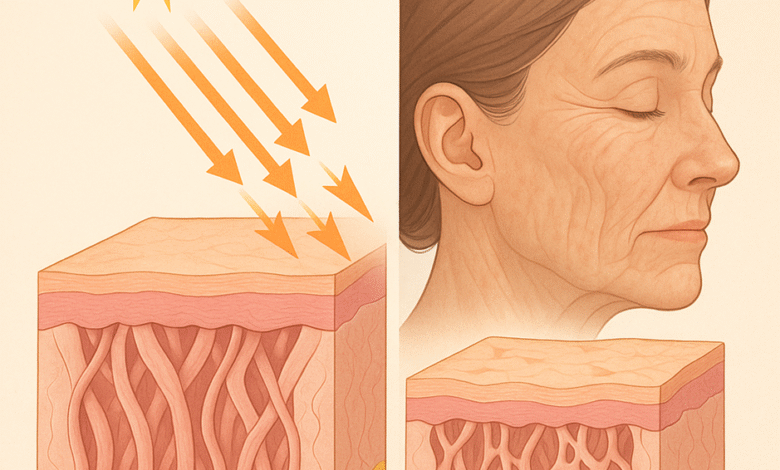
Skin aging cannot be explained merely as a natural phenomenon that appears with increasing age. In fact, research shows that a significant portion of skin aging is accelerated by ultraviolet (UV) radiation, a process referred to as “photoaging.” The ultraviolet rays in sunlight are invisible and may not cause immediate discomfort, but they gradually induce changes in the skin’s internal structure on a daily basis. Most notably, they rapidly damage collagen, the protein essential for maintaining skin elasticity and thickness, leading to wrinkles, sagging, pigmentation, and a variety of skin changes.
The Meaning and Function of Collagen
The skin is composed of the epidermis, dermis, and subcutaneous fat layer, among which the dermis accounts for the majority of skin thickness. Within the dermis, collagen and elastin fibers are densely arranged, serving as pillars that support the skin. When collagen is maintained in a healthy state, the skin appears thick, elastic, smooth, and radiant.
Collagen is synthesized by fibroblasts and undergoes continuous metabolic turnover. Under normal conditions, synthesis and degradation remain balanced, maintaining both quality and quantity. However, external factors such as ultraviolet radiation, smoking, environmental pollution, and stress disrupt this balance. Ultraviolet radiation in particular inhibits collagen synthesis while accelerating its breakdown, thereby hastening skin aging dramatically.
Types of Ultraviolet Radiation and Modes of Penetration
Ultraviolet radiation is classified by wavelength into UVA, UVB, and UVC. UVC is mostly blocked by the stratospheric ozone layer and therefore has little effect on human skin. UVA and UVB, however, continuously stimulate the skin in daily life.
UVA has a longer wavelength and penetrates deeply into the dermis. Repeated, long-term exposure weakens collagen and alters the skin’s structural framework, resulting in fine wrinkles and loss of elasticity. In contrast, UVB has a shorter wavelength and primarily affects the epidermis. It induces strong, immediate damage such as sunburn, erythema, hyperpigmentation, and even DNA mutations.
Although their sites of action differ, both UVA and UVB contribute significantly to skin aging and deterioration of skin health. Particularly concerning is that UVA easily penetrates clouds and glass, making indoor exposure a constant risk. Many people believe they are safe from UV radiation when sunlight is not directly shining on their skin, but in reality, collagen in the dermis continues to be damaged consistently.
The Process by Which Ultraviolet Radiation Destroys Collagen
When UV radiation reaches the skin, it triggers the explosive generation of reactive oxygen species (ROS). These ROS attack mitochondria, cell membranes, and DNA, causing oxidative damage. Although the skin’s intrinsic antioxidant systems can control ROS to a certain extent, repeated and excessive UV exposure overwhelms these defenses.
A critical change in this process is the upregulation of matrix metalloproteinases (MMPs). These enzymes normally degrade damaged collagen to allow renewal, but after UV exposure, their overactivation leads to the breakdown of even healthy collagen. At the same time, dermal fibroblasts become functionally impaired, reducing new collagen synthesis. Consequently, the skin enters a vicious cycle in which existing resources are rapidly depleted without adequate replacement.
Visible Changes in the Skin
Collagen degradation does more than create wrinkles; it causes a spectrum of changes across the skin, becoming increasingly noticeable.
First, the skin becomes thinner, producing both fine and coarse wrinkles. The collapse of the dermis results in surface depressions and creases. Second, elasticity decreases, causing skin to sag downward under gravity, blurring facial contours and worsening ptosis. Third, the skin barrier weakens, leading to dryness and heightened sensitivity. This manifests as reduced water retention, increased cracking, and redness in response to minor irritation.
Additionally, irregular hyperpigmentation develops, with worsening spots, melasma, and freckles. Vasodilation may create a persistently red appearance, while pores enlarge, giving the skin a lax and coarse look. Ultimately, ultraviolet radiation acts as a comprehensive accelerator of aging.
The Importance of Sun Protection
The most effective method of preserving collagen in the skin is prevention rather than treatment. Central to this is the consistent practice of photoprotection. Using sunscreen with appropriate SPF and PA ratings, applied each morning and reapplied every 2–3 hours when necessary, is essential. For those exposed to water or sweat, water-resistant formulations are preferable.
Physical barriers also play an indispensable role. Wearing hats, long-sleeved clothing, and sunglasses reduces direct UV exposure considerably. Avoiding outdoor activity between 10 a.m. and 3 p.m., when UV radiation is most intense, and seeking shade when possible are further preventive measures.
Methods to Restore Damaged Collagen
Although completely restoring collagen once destroyed is difficult, it is possible to stimulate the skin’s regenerative capacity to induce gradual recovery. Improvement begins with dietary and lifestyle modifications. Regular intake of foods rich in antioxidants such as vitamin C, vitamin E, omega-3 fatty acids, and polyphenols reduces oxidative stress and supports skin repair.
In modern aesthetic medicine and dermatology, techniques that stimulate the dermis and reactivate fibroblast activity are widely used to encourage new collagen formation. Among these, skin booster treatments directly deliver bioactive substances into the dermis, enhancing the damaged dermal environment and promoting elasticity restoration. This approach addresses aspects that cannot be improved by topical cosmetics alone, providing tangible support for collagen regeneration.
Q&A on Collagen and Ultraviolet Radiation
- Is sunscreen unnecessary on cloudy days?
A. No. UVA penetrates clouds almost completely and continues to damage the dermis. Sunscreen is essential regardless of weather conditions. - Which is more harmful: one-time intense exposure or frequent short exposures?
A. Both contribute to collagen damage, but frequent, repetitive exposures are often more harmful long-term, as small, cumulative injuries progressively weaken the skin’s structure. - Can tanning delay aging in some cases?
A. No. While darker skin tones may show less visible sunburn, collagen degradation occurs universally across all skin colors. Skin aging progresses regardless of pigmentation. - Can wrinkles and sagging occur despite daily use of sunscreen?
A. Yes. Sunscreen cannot block 100% of UV rays. Inadequate application, insufficient amounts, or failure to reapply in time may all reduce its protective efficacy. - When is the best time to begin treatments that restore collagen?
A. The ideal time is when fine lines or thinning skin first become noticeable. Beginning earlier enhances preventive effects, while in later stages it accelerates recovery of already aged skin.
Conclusion
Ultraviolet radiation is not merely an external environmental factor but the most powerful accelerator of skin aging. By penetrating deep into the skin, it destroys collagen and suppresses its synthesis, undermining the entire structural integrity of the skin. As a result, visible changes such as wrinkles, sagging, pigmentation, and dryness occur.
The surest preventive measure is the consistent practice of sun protection in daily life. For existing damage, antioxidant support and dermatological procedures that directly stimulate collagen production provide additional benefit.
Ultimately, maintaining youthful and healthy skin depends on balancing prevention with recovery. Continuous photoprotection and appropriate interventions represent the most effective and intelligent means of preserving dermal collagen.