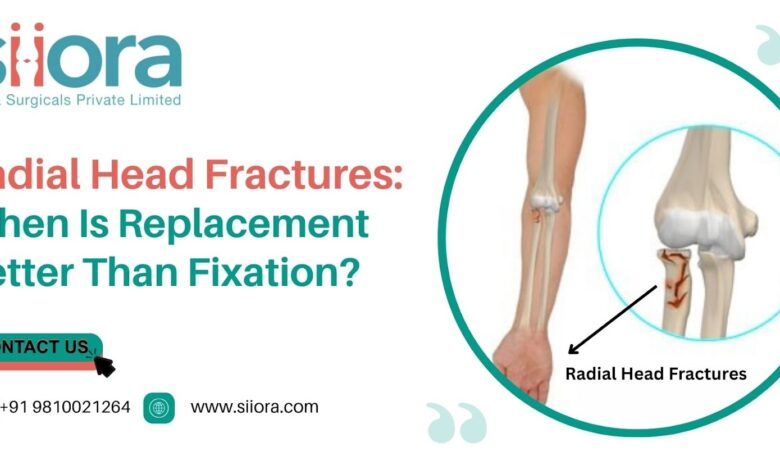
Radial head fractures are more common than most people realize. They account for about a third of all elbow fractures and typically occur when someone falls on an outstretched arm. Whether it’s a mild crack or a complex break, these injuries can be tricky, especially when it comes to deciding between fixation and radial head replacement.
But how do surgeons decide which route to take? And when is replacing the radial head actually the better option than trying to fix what’s broken?
Let’s break it down in simple terms.
What is the Radial Head?
The radial head is the top part of the radius bone, which sits on the outer side of your forearm. It helps with the rotation of the arm (like when you turn a doorknob) and also keeps the elbow joint stable. So, when it’s injured, restoring function and stability is key.
Fractures of the radial head vary in severity. Some are simple cracks that barely move out of place, while others shatter the bone into multiple fragments. That’s where the decision-making begins.
Fixation: Trying to Preserve What’s There
Fixation usually involves using screws or plates to hold the broken pieces of bone together while they heal. It works well for fractures that are clean and don’t involve too many fragments. Surgeons prefer this method when the pieces are large enough to be put back together and the joint surfaces are relatively intact.
Fixation has its perks, mainly that it keeps your original bone in place. This is often ideal for younger patients or those with good bone quality. The goal here is to promote natural healing and return to normal function.
However, fixation isn’t always perfect. If the bone is shattered into many tiny pieces (what doctors call “comminuted”), trying to piece it all back together can be like solving a jigsaw puzzle with missing parts. In these situations, fixation may lead to complications like joint stiffness, instability, or even failure of the hardware.
Replacement: Knowing When to Let Go
Radial head replacement comes into play when the fracture is too complex to fix reliably. Instead of trying to reassemble broken fragments, the surgeon replaces the damaged radial head with an artificial implant, usually made of metal.
This option is often recommended in the following scenarios:
- The bone is fragmented into too many pieces.
- The fracture is associated with ligament injuries or elbow dislocations.
- Previous attempts at fixation have failed.
- The patient needs early mobility and reliable stability—for instance, athletes or manual workers.
Radial head prosthesis tends to provide more predictable results in these tough cases. It helps maintain elbow stability, especially when other structures around the joint (like ligaments) are also damaged. Patients often regain movement faster and have a lower risk of complications like nonunion (when the bone doesn’t heal) or chronic pain.
Choosing the Right One
There’s no one-size-fits-all answer. The choice between fixation and replacement depends on several factors: the type and severity of the fracture, the patient’s age and activity level, bone quality, and the presence of other injuries around the elbow.
In some cases, a hybrid approach may even be used. There, one part of the bone is fixed using orthopedic plates, and another part is replaced.
What Patients Should Know?
If you or someone you love suffers a radial head fracture, don’t hesitate to ask questions. Understand the pros and cons of both options, and be sure to work with an experienced orthopedic surgeon who specializes in elbow injuries.
Recovery is possible in both cases, but the path can vary. Physical therapy plays a major role, so stay committed to the rehab plan your doctor recommends.
At the end of the day, the goal is to restore function, reduce pain, and get you back to the activities you love, whether that’s turning a doorknob or swinging a tennis racket.