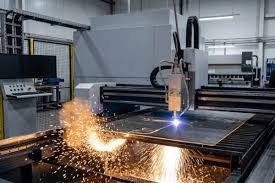
Everything from the structural framework of towering skyscrapers to the intricate components inside your smartphone relies on metal. But raw metal rarely arrives in a usable state. It requires shaping, cutting, and assembling to meet specific functional requirements. This transformation is the core of custom metal fabrication.
Overview of Common Fabrication Processes
Fabricators use a wide array of techniques to turn flat sheet metal or thick metal bars into finished products. Most projects require a combination of these methods to achieve the final design.
Cutting
Cutting is usually the first step in any metal fabrication project. It involves separating a piece of metal into smaller sections or carving out specific shapes.
- Shearing: A machine uses a long blade to slice through sheet metal in straight lines. It works much like a giant pair of scissors.
- Sawing: Traditional mechanical saws, such as band saws, cut metal bars and structural shapes down to the required length.
- Laser Cutting: High-powered lasers melt and vaporize the metal, leaving a highly precise, clean edge. It works exceptionally well for intricate designs on thinner materials.
- Plasma Cutting: This method uses an accelerated jet of hot plasma to cut through electrically conductive materials. It is faster than laser cutting for thick steel plates.
- Waterjet Cutting: A high-pressure stream of water mixed with abrasive particles cuts through the metal. Because it does not use heat, waterjet cutting prevents warping or thermal distortion.
Bending
Bending alters the shape of the metal without removing any material. It requires specialized machinery to apply the exact amount of force needed to create an angle or curve.
- Press Brakes: A press brake forces sheet metal into a V-shaped or U-shaped die using a heavy punch. This creates precise, sharp angles and bends.
- Roll Bending: Rollers gradually bend metal sheets or tubes into large curves, cylinders, or cones.
Forming
Forming goes a step beyond bending by reshaping the metal into complex 3D objects using molds or dies.
- Stamping: A mechanical press uses a specialized die to punch or form a shape into a metal sheet in a single stroke.
- Deep Drawing: A punch forces flat sheet metal into a hollow die, creating a cup or box shape. The depth of the drawn part is greater than its diameter.
- Spinning: A disc of sheet metal rotates at high speeds while a roller presses it against a block, forming symmetrical, hollow shapes like bowls or cones.
Machining
Machining removes material from a solid block of metal to achieve a specific, highly precise shape.
- Milling: Rotating cutting tools remove material from the surface of a stationary metal piece. It creates flat surfaces, slots, and complex contours.
- Turning: The metal workpiece rotates while a stationary cutting tool shaves off material. Facilities often use CNC lathe machining for turning operations to produce perfectly cylindrical parts with extreme accuracy.
- Drilling: A rotating drill bit creates circular holes in the metal.
Welding
Welding joins two or more pieces of metal together using intense heat to melt the parts, allowing them to fuse as they cool.
- MIG (Metal Inert Gas): A continuous solid wire electrode is fed through a welding gun. It is fast, easy to learn, and great for thick materials.
- TIG (Tungsten Inert Gas): This uses a non-consumable tungsten electrode. It requires a high level of skill but produces incredibly clean, strong welds suitable for thin metals.
- Stick Welding: An electrode covered in flux is used to lay the weld. It works well outdoors and on rusty or dirty metals.
- Spot Welding: Copper electrodes clamp sheet metal together and pass a strong electrical current through the pieces, melting them together at a specific point.
Finishing
The finishing process protects the metal from corrosion, improves its appearance, and prepares it for end-use.
- Grinding: Abrasive wheels smooth out rough welds and sharp edges.
- Polishing: Compounds and buffing wheels create a smooth, reflective surface.
- Coating: Applying paint, powder coating, or anodizing protects the metal from rust and adds a decorative color.
Factors to Consider When Choosing a Fabrication Process
Selecting the right fabrication process requires careful planning. First, evaluate the material type. Some metals, like aluminum, are highly malleable and easy to form, while titanium requires specialized cutting tools.
Next, consider your production volume. Stamping is highly cost-effective for producing thousands of identical parts, but the initial tooling costs make it impractical for a single prototype. Conversely, laser cutting requires no custom tooling, making it perfect for small runs.
Finally, assess the required precision. Aerospace components demand the tight tolerances of machining, while structural steel brackets may only require basic shearing and welding.
The Importance of Custom Metal Fabrication in Various Industries
Custom metal fabrication drives innovation across numerous sectors. In the automotive industry, fabricators create lightweight aluminum frames to improve fuel efficiency. The medical field relies on precise machining and TIG welding to produce sterile surgical tools and durable implantable devices.
Construction companies depend on heavy structural steel fabrication to build bridges and high-rises. Even the food processing industry utilizes custom fabrication to design stainless steel vats and conveyors that meet strict hygiene standards. Without custom fabrication, these industries would struggle to adapt to new technological demands.
Conclusion
The custom metal fabrication industry constantly evolves to meet higher standards of speed and precision. Automation and robotics are now handling repetitive welding and material handling tasks, reducing production times and improving safety. Software advancements allow engineers to simulate bending and forming processes before cutting a single piece of metal, drastically reducing material waste.