Taking online courses has been a game-changer for me, offering the flexibility I needed to balance my studies with other commitments. However, I quickly realized that the freedom of online learning comes with a huge responsibility: you have to be your own motivator and create your own structure. It took some trial and error, but I’ve discovered a few study techniques that have been incredibly effective in my online learning journey.
Here are my top 5 study techniques that actually work for online courses, along with personal examples of how they’ve been effective for me.
1. I Carved Out My Own “Classroom”
At first, I thought one of the perks of online learning was that I could study anywhere – my couch, my bed, the kitchen table. I soon found that this was a recipe for disaster. My brain associated those places with relaxation, and I’d get easily distracted.
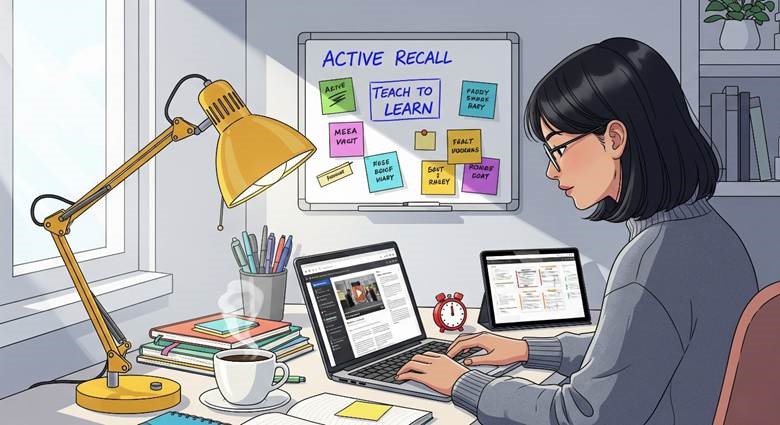
So, I created a dedicated “study nook.” It’s nothing fancy, just a small desk in the corner of my room. But it’s my designated space for all things related to my online courses. When I sit at that desk, it signals to my brain that it’s time to focus.
I have all my essentials within reach: my laptop, notebooks, pens, and a good lamp. This simple act of creating a physical boundary between my study time and personal time has made a massive difference in my productivity and ability to concentrate.
2. The Pomodoro Technique is My Secret Weapon Against Procrastination
I used to get overwhelmed by long reading assignments or complex topics. I’d procrastinate because the task just seemed too big. Then, I discovered the Pomodoro Technique. This time management technique breaks down work into focused intervals of time.
Here’s how I use it: I set a 25-minute timer. Within this 25-minute window, I focus intensely on a single task and do my online class without any distractions. No checking my phone, no browsing social media – just pure, uninterrupted work. When the timer rings, I take a short 5-minute break to stretch, grab some water, or look out the window. After four of these “Pomodoros,” I take a more extended break of 15-30 minutes.
For example, when faced with a 50-page chapter, I break it down into Pomodoro sessions. I’ll read for 25 minutes, then take a quick break. It makes the task feel much more manageable and helps me stay focused without burning out.
3. I “Teach” to Learn with Active Recall
Passive learning, such as simply reading a textbook or watching a lecture, doesn’t significantly enhance my long-term memory. I’ve found that active recall, the process of actively retrieving information from your brain, is far more effective.
My favorite active recall technique is a simplified version of the Feynman Technique. After I’ve studied a new concept, I explain it out loud in the simplest terms possible, as if I were teaching it to someone who knows nothing about the subject.
Sometimes I’ll even explain it to my dog! This process quickly reveals any gaps in my understanding. If I can’t explain it, I need to go back and review the material.
4. Digital Flashcards and Spaced Repetition Are a Lifesaver
Remembering key terms and concepts is crucial in any course. For my online classes, I’ve become a massive fan of digital flashcard apps that use spaced repetition. This technique involves reviewing information at increasing intervals over time, which has been proven to improve long-term retention.
I create flashcards for all the essential terminology in my courses. The app then quizzes me on them, showing me the cards I struggle with more frequently. This is significantly more efficient than simply rereading my notes.
For instance, in my statistics course, I used digital flashcards to memorize formulas and their applications. Seeing them regularly helped cement them in my memory for the exams.
5. I Became an Active Participant in My Online Community
It’s easy to feel isolated in an online course. At first, I was hesitant to participate in the online discussion forums. But I soon realized that engaging with my classmates and instructors was a powerful study tool.
Writing out my thoughts on a topic and responding to my peers’ posts forces me to think critically about the course material. I remember struggling with a complicated concept in a programming class and thought of asking someone to take my online class for me.
However, I then posted a question on the forum, and not only did my instructor provide a clear explanation, but a few of my classmates also chimed in with their ways of understanding it. This collaborative learning experience was invaluable and helped me feel more connected to the class.
Conclusion
The transition to online learning was a journey of discovery for me, but by adopting these strategies, I’ve been able to thrive in a flexible and rewarding educational environment. Creating a dedicated study space, mastering my time with the Pomodoro Technique, actively recalling what I’ve learned, using innovative flashcard systems, and engaging with my online community have been the pillars of my success.
Ultimately, finding what works for you is a personal process of trial and error. Don’t be afraid to experiment with different techniques until you find the perfect combination that helps you stay motivated, focused, and successful in your online courses. The key is to be proactive and intentional about how you approach your studies.
What study technique has been a game-changer for you? Share your experience in the comments below!