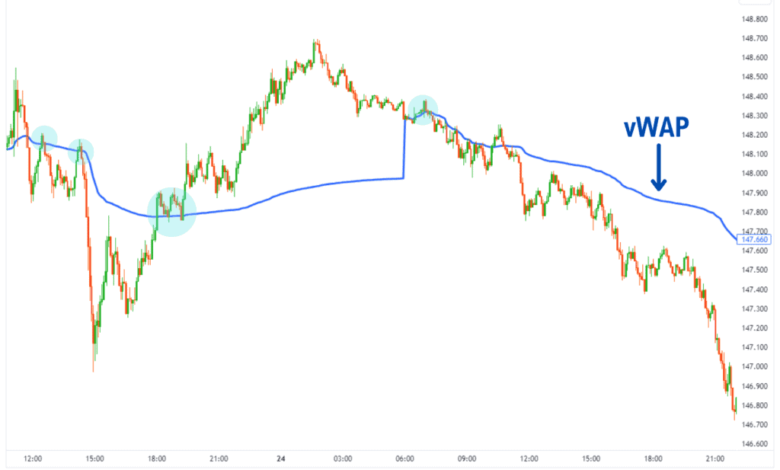
The Volume Weighted Average Price (VWAP) continues to be one of the most respected and widely used indicators in financial markets. In 2025, as trading becomes more automated and data-driven, VWAP is undergoing a transformation. Originally designed as a simple way to determine the average price at which a security has traded throughout the day, weighted by volume, VWAP is now being employed in increasingly complex strategies. Traders and institutions alike are refining their approaches to integrate VWAP with AI models, smart execution algorithms, and high-frequency strategies, all while maintaining its foundational purpose: to identify fair value in real time.
The Core Value of VWAP in Intraday Trading
VWAP is particularly effective for intraday analysis because it merges price data with volume, giving traders insight into the real trading activity behind price moves. Unlike a simple moving average that only accounts for price over time, VWAP reflects how much capital has been deployed at various price levels, offering a more nuanced picture of market sentiment. This makes it especially useful for institutional traders who aim to execute large orders without moving the market, as well as for retail traders looking to confirm intraday trends. When price is above VWAP, the market is generally considered bullish; when it’s below, the sentiment leans bearish. This clarity makes VWAP an invaluable guide, especially when markets are volatile or directionless.
Integration with Automation and AI-Driven Systems
In today’s trading environment, VWAP is no longer just a static line on a chart—it’s a dynamic component within automated trading systems. Traders are programming custom scripts and webhook-based algorithms to trigger trades based on real-time interactions with the VWAP line. These setups often involve conditional logic, where trades are only executed if volume thresholds, volatility patterns, and VWAP alignment all converge. Additionally, machine learning models are now enhancing VWAP-based strategies by accounting for evolving market structures. AI-powered indicators adjust in real time to detect whether VWAP deviations are likely to revert or extend, based on historical data, liquidity trends, and news sentiment. This integration of human logic and machine precision is allowing VWAP to maintain its relevance in a landscape dominated by speed and adaptability.
VWAP as a Strategic Benchmark for Institutions
For institutional investors and asset managers, VWAP remains the gold standard for benchmarking trade execution. When managing large portfolios, institutions break up orders into smaller trades and aim to execute them as close to the VWAP as possible to minimize market impact and slippage. This approach not only preserves capital but also meets regulatory and client demands for transparent execution. In this context, VWAP is more than an indicator—it’s a measure of efficiency and fairness. With the proliferation of real-time analytics and execution platforms, institutions can now track VWAP performance live, make adjustments to execution algorithms on the fly, and even share VWAP-based reports with clients as proof of optimized order handling.
VWAP’s Expanding Influence in Crypto and Decentralized Markets
As the world of trading expands beyond traditional stock exchanges, VWAP is beginning to find applications in cryptocurrency and decentralized finance (DeFi). While many crypto markets lack the centralized volume data needed for precise VWAP calculations, several exchanges and analytics platforms are adapting the concept to on-chain data. In some cases, DeFi protocols are using volume-weighted pricing to calculate token issuance or trading ranges, effectively mirroring the VWAP logic in a decentralized environment. This is especially relevant as crypto markets operate 24/7, making intraday benchmarks like VWAP crucial for strategy development and execution monitoring.
A Forward-Looking Indicator in an Adaptive Market
Looking ahead, VWAP is likely to remain a cornerstone of market analysis, but its applications will continue to evolve. As trading becomes more fragmented across platforms and asset classes, the need for volume-aware indicators will grow. Traders who adapt VWAP to include cross-market data, AI filtering, and real-time execution feedback will gain a significant edge. Moreover, with the rise of decentralized autonomous organizations (DAOs), tokenized assets, and algorithmic market makers, VWAP may even become a protocol-native tool embedded in smart contracts and trading bots. In this environment, VWAP’s simplicity and effectiveness ensure that it will not only survive but thrive as one of the few indicators capable of adapting to both traditional finance and the new digital frontier.